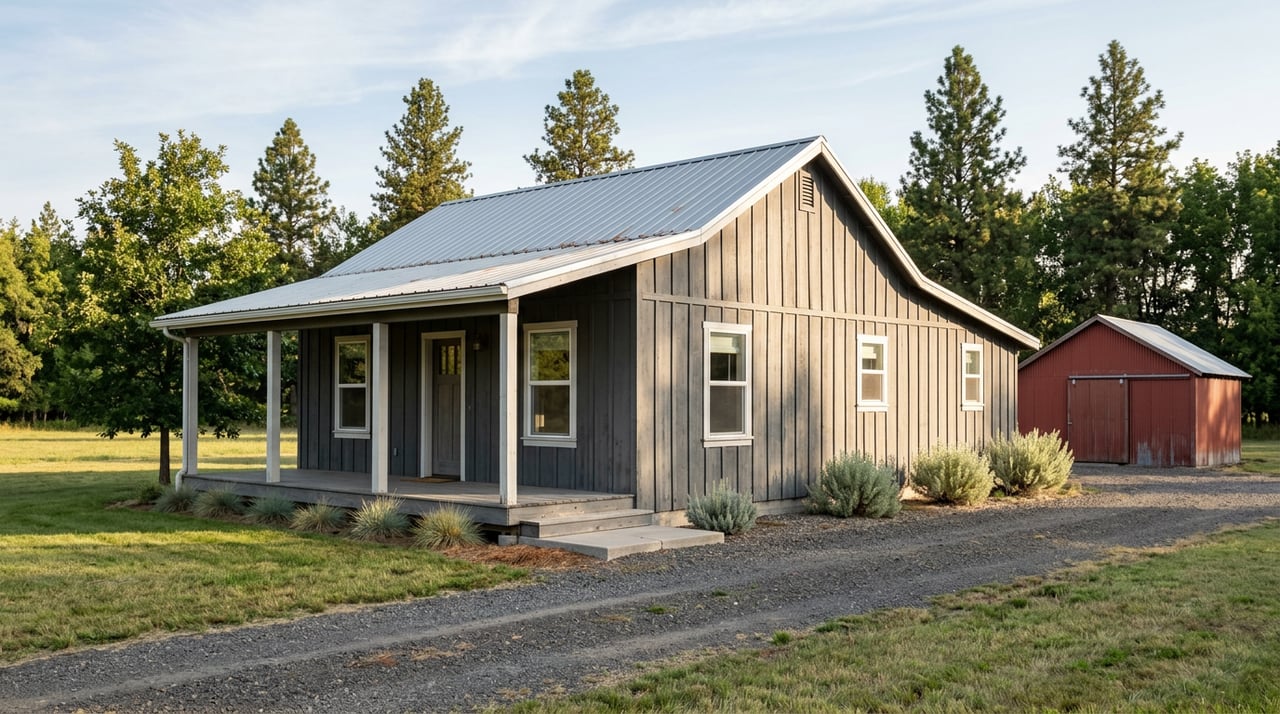
A buyer walks a five-acre parcel outside Selah, sees a ditch running along the back fence line, and assumes the water that fills it comes with the deed. It usually does not. In the Yakima Valley, irrigation water is a separate legal right from the land it sits on, and whether it transfers to a new owner depends on paperwork that has nothing to do with the purchase price or the size of the lot.
That distinction rarely shows up on a listing sheet. It shows up at closing, when a title search turns up a canal easement nobody mentioned, or the following July, when a new owner discovers their turnout delivers a fraction of what the seller described. For anyone buying acreage, a rural lifestyle property, or even an in-town home on Yakima's west side, this is the one due diligence item that behaves differently here than almost anywhere else buyers may have lived before.
Yakima's Water Map Has No Single Provider
There is no citywide irrigation utility that covers the Yakima area the way a single water district might in other parts of the country. Instead, the valley is served by a long list of separate districts and canal companies, each with its own boundaries, rates, and rules: Yakima-Tieton Irrigation District, Ahtanum Irrigation District, Terrace Heights Irrigation District, Roza Irrigation, Selah-Moxee Irrigation District, Naches-Selah Irrigation District, South Naches Irrigation District, Wenas Irrigation District, Sunnyside Valley Irrigation District, Nob Hill Water, Yakima Valley Canal, Fowler Ditch, and Gleed Canal, among others.
That patchwork runs into town, too. The Naches-Cowiche Canal Association delivers irrigation water to residential properties roughly from 40th Avenue on the west side to Interstate 82 on the east, and from the Naches River down to Wide Hollow Creek, with its lines running alongside and sometimes intermingled with the City of Yakima's own system and other private companies. The overlap is dense enough that the association's own guidance for a homeowner trying to figure out who actually delivers their water is simply to ask a neighbor.
That is not a knock on any single organization. It is a reflection of how this valley was settled: ditch by ditch, company by company, starting in the 1880s, long before anyone was thinking about how a 2026 buyer would trace ownership. Many of those old canal easements, typically extending 10 to 20 feet on either side of the ditch centerline, were recorded against properties decades ago and can be buried under generations of subdivisions and title transfers. They may not surface on a routine title report at all.
Water Rights Are Not Automatically Included in the Sale
Here is the part that catches people off guard. Even when a parcel clearly has an irrigation right attached to it, that right does not automatically follow the land into a new owner's hands. Yakima-Tieton Irrigation District, for example, requires its own Water Transfer Deed for any change of ownership involving water shares, and the cost of those shares is negotiated separately between buyer and seller, not set by the district. The district also caps transfers at no more than 1.5 shares per irrigable acre and charges a $150 fee per transfer, on top of a service charge if the change requires physically adjusting a turnout.
In practice, this means a buyer needs the exact number of shares that will transfer written into the purchase agreement, not a verbal assurance that "the property has irrigation." A parcel can look identical to its neighbor and carry a completely different water entitlement, because the right is priced and transferred like a distinct asset rather than something baked into square footage or acreage.
The same logic applies to older canal-company water. Because those rights and easements were often established informally in the 1880s, and may rely on longstanding use rather than a document anyone can pull up easily, confirming what actually transfers with a specific parcel sometimes takes more digging than a standard title search provides.
The Assessment Is a Lien, and It Doesn't Always Look Like One
Irrigation water in this valley comes with an annual bill, and that bill is not optional once a property carries water shares. Yakima-Tieton Irrigation District charges become due February 15 each year, delinquent by May 1, and unpaid balances accrue interest at 12 percent annually, with the district authorized to foreclose the same way a county treasurer forecloses on unpaid property taxes. Selah-Moxee Irrigation District handles it differently: its assessments are folded directly into the parcel's annual property tax statement from the Yakima County Treasurer's Office, which means a buyer's title company needs to check with the Treasurer specifically for current irrigation assessments rather than assuming a clean property tax bill tells the whole story.
The dollar amounts scale with the number of shares, not the size of the house. A farmland parcel served by Yakima-Tieton and currently listed publicly illustrates the range: one tract with roughly 19 water shares carried a 2025 irrigation assessment of about $3,300, while a larger tract in the same portfolio with about 337 shares carried an assessment near $58,200. Most Yakima home buyers are not managing hundreds of shares, but the principle holds at any scale. Two properties that look similar on paper can carry very different ongoing costs depending on exactly how much water is attached and how that water is billed.
Why This Matters More in 2026 Than It Did a Few Years Ago
Water rights have always been a due diligence item in this valley. What has changed is the stakes. The Yakima Basin is now in its fourth consecutive year of drought, and in October 2025 the Washington Department of Ecology took a step that had never happened before: it restricted surface water use across the entire basin, affecting more than 1,500 water right holders, in order to protect the most senior rights during a season when reservoir storage had fallen to around 8 percent of capacity, among the lowest levels on record.
That curtailment worked through Washington's priority date system, sometimes summarized as first in time, first in right. Rights confirmed through the Ecology v. Acquavella adjudication, finalized in a 2019 decree and settled on appeal in 2021, are ranked by the date they were established. Water rights dating to 1905 or earlier, the priority date tied to the original Yakima Project, are far more insulated from cuts than rights established later. In practice, this means the specific priority date attached to a parcel's water right, not just whether it has one, determines how secure that water actually is in a dry year.
The pressure hasn't eased in 2026. In May, four senior districts, Naches-Selah, Selah-Moxee, Sunnyside Valley, and Yakima-Tieton, jointly petitioned Ecology to administer water strictly by priority date through the full irrigation season, arguing that last year's curtailment came too late to protect their more senior rights. Reclamation's own forecasts this spring put proratable water users at roughly half their normal supply. None of this means a Yakima property with irrigation water is a bad investment. It does mean a buyer evaluating acreage or a rural lifestyle property this year has more reason than usual to ask which specific right serves the parcel, how senior that right is, and how it fared during the 2025 shutoff.
Questions Worth Asking Before You Write an Offer
- Which specific district or canal company delivers water to this parcel, not just the general area
- How many shares or how much water actually transfers with this sale, spelled out in the purchase agreement rather than assumed from the listing
- What the current assessment is, whether it is paid current, and whether it shows up on the county tax statement or arrives as a separate bill
- What happened to this specific right during the October 2025 curtailment, if the seller or district can speak to it
These are the same questions worth raising whether the property sits on acreage near Selah, in the orchard country around Moxee, or on an in-town lot inside the Naches-Cowiche Canal Association's service area. If you are still weighing acreage against an in-town lot in the first place, our guide to choosing acreage or in-town living is a useful next stop. Water in this valley is local down to the parcel level, and the only way to know what you are actually buying is to ask.
A Local Question Deserves a Local Answer
None of this is a reason to avoid acreage or rural property in the Yakima Valley. It is a reason to treat the water question with the same seriousness as inspection results or appraisal timing, and to have someone in your corner who knows which district serves which street and what a share transfer actually requires.
If you are weighing acreage, a move-up property, or an in-town home anywhere in the Yakima area, Jeremy and Lindsay can walk through exactly what water rights and assessments apply to a specific parcel before you write an offer. Schedule a Consultation to start with the questions that actually matter for your situation.
A Few Common Questions
Does every home in Yakima have an irrigation water right? No. Many in-town properties rely solely on municipal or domestic water, while others, particularly on the west side and in outlying areas, carry a separate irrigation right through a canal company or district in addition to domestic water.
If a property had reliable irrigation for years, will it keep getting water in a drought? Not necessarily. Reliability depends on the priority date of the specific right. Senior rights, generally those established at or before 1905, have historically kept receiving water even during proration, while junior rights are the first cut. The unprecedented full-basin curtailment in October 2025 showed that even senior rights are not entirely immune in extreme years.
Can a buyer add irrigation water to a property after closing that didn't have it before? Sometimes, depending on the district and whether the parcel falls within its boundaries and is classified as irrigable, but this involves separate negotiation, district approval, and fees. It is not something to assume will happen easily after the fact, which is exactly why confirming what exists before closing matters so much.